Netilardo The Deep Places of the World
Naming the Dwarves
Oh, boy. This is going to be a tough one.
What do you do if you want to give your dwarven characters canonical names? Not names like Thorin and Balin - those are Old Norse, tacked on in the process of Tolkien's 'translation'. No, I'm talking about when you're the sort of person who names the hobbits Maura, Ban, and Kali - who uses 'Mithrandir' for Gandalf because it's Elvish, and therefore accurate. Eight of the Fellowship have either true Westron, or Elvish, names. The exception is Gimli. Of course, if you're writing Hobbit fanfic, the situation is even worse - only Bilbo and Gandalf have genuine Middle-earth names available.
You can't use his true, Khuzdul name - the dwarves never reveal those, we simply have nothing to go on. But the name 'Gimli' does represent a real name - a name in the language of Dale.
And therein lies the problem. We know exactly one word of genuine Dalish - 'Tragu', the true name of Smaug. I doubt you want a bunch of dwarves named Smaug running around, so we're going to have to turn to comparative linguistics.
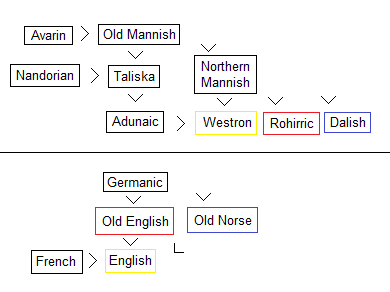
Languages highlighted in the same colour are translation pairs - Tolkien 'translated' one into the other. So the closely-related languages of Old English and Old Norse represented the similarly-related languages Rohirric (and, for that matter, Northern Mannish), and Dalish. For the purposes of this discussion, we will actually assume Rohirric and Northern Mannish to be identical. This isn't too farfetched - Rohirric kud-dukan, 'hole-dweller', seems to be the same term that, 1500 years earlier, the Hobbits adopted and began to wear down into kuduk, 'Hobbit'.
The Northern word Trahald, 'Smeagol', is a close relative of Dalish Tragu, 'Smaug'. It suggests a Rohirric > Dalish shift of h > g, at least in some circumstances - so Lohtur, 'Eotheod', might appear in Dalish as something more like Logtur. So we have a second possible Dalish word to work with - in addition to trag, 'to burrow' (Smaug is the past tense), we have log, 'horse' (from R. loho-).
More technically, this change of h to g is the voiceless glottal fricative turning into the voiced velar stop. Can we generalise this change? Is there a general shift from voiceless to voiced - so that k would also become g, creating D. gud 'hole' and dugan 'dweller' (and thus, possibly, dug for 'house')? Or should we look for fricatives becoming stops, so that th and f become p or t? Perhaps even both - so that voiceless fricative th becomes voiced stop d, while f becomes b?
Even if you find a set of changes that satisfy you, the corpus is still horribly thin. There are only a handful of Rohirric/Mannish words: Trahand and Nahand (Smeagol and Deagol), trahan (a burrow), kastu (a mathom), kud-dukan (hole-dweller), loho and lo- (horse), Lohtur (Eotheod), Lograd (Riddermark), Turac (Theoden, or 'king' - apparently tur-rac), and rog, pl. rogin (Wose).
Our attested Rohirric/Mannish consonants are thus: c, d, g, h, k, l, n, r, s, t. We have consonant clusters tr, nd, and gr. Not much to go on.
But we know that Westron is closely related to Rohirric. Hobbitish Westron in particular - they have the words Kuduk, kast, and tran, from kud-dukan, kastu, trahan. Are there any genuine Westron words related to our Rohirric terms? We have 'banakil', meaning 'hobbit', but it comes from 'halfling', not 'hole-dweller'. The word nas means 'people', which could be connected to R. tur ('folk') - but there is no obvious etymological connection. Possibly more useful is W. suza, 'sphere of occupation' - could this give us a R. > W. shift of t > s, and z > r? That would suggest that Westron favoured silibants, while retaining the placing - t and s are both voiceless alveolars, while z and r are both voiced alveolars.
We also have 'phur-', 'to delve', which could be distantly related to 'trah'; that would suggest a R. > W. shift of tr > f, which could conceivably be r > f (if the t is lost) - a complete change, unfortunately. h > r is about as bad, so let's assume those words are not related.
So trying to link Westron to Rohirric directly is mostly a dead end; we can suggest creating Rohirric words by moving away from silibants, but it is difficult to decide where to move to. What about another angle of attack?
Westron is not, as some may think, a debased form of Adunaic. Rather, it is Adunaic, mixed with Sindarin (and a little Quenya), mixed with Mannish. Since Adunaic is itself a descendent of Old Mannish - with some Elvish influences - tt follows that any differences between Adunaic and Westron which do not come from Elvish, may have a Mannish origin.
The Westron word batta ('talker') is related to Adunaic bzth ('word'); can we suppose that Adunaic th represents Old Mannish t?
One direct connection between Adunaic and Mannish is the A. word Aru, 'king'. Since we have Rohirric tur-rac, which must mean 'folk-king', can we conjecture a word 'Arac', and a common ancestor 'Arc'? If so, any -ru in Adunaic could have an -rac counterpart in Rohirric - so perhaps A. naru, 'male', has an equivalent 'narac'? Equally, rukh, 'shout', might simply be Mannish rac, while ugru 'shadow' becomes ugrac. Urud & urug, 'mountain' and 'bear', could produce urad and urag - suggesting, just possibly, a name for Beorn. Arag? Urag? Maybe even Arak or Urak. The similarity to Orc would certainly explain Bilbo's skittishness!
So: with all this, can we suggest any names for the dwarves of the Third Age? We can certainly have a go!
What do you do if you want to give your dwarven characters canonical names? Not names like Thorin and Balin - those are Old Norse, tacked on in the process of Tolkien's 'translation'. No, I'm talking about when you're the sort of person who names the hobbits Maura, Ban, and Kali - who uses 'Mithrandir' for Gandalf because it's Elvish, and therefore accurate. Eight of the Fellowship have either true Westron, or Elvish, names. The exception is Gimli. Of course, if you're writing Hobbit fanfic, the situation is even worse - only Bilbo and Gandalf have genuine Middle-earth names available.
You can't use his true, Khuzdul name - the dwarves never reveal those, we simply have nothing to go on. But the name 'Gimli' does represent a real name - a name in the language of Dale.
And therein lies the problem. We know exactly one word of genuine Dalish - 'Tragu', the true name of Smaug. I doubt you want a bunch of dwarves named Smaug running around, so we're going to have to turn to comparative linguistics.
Languages highlighted in the same colour are translation pairs - Tolkien 'translated' one into the other. So the closely-related languages of Old English and Old Norse represented the similarly-related languages Rohirric (and, for that matter, Northern Mannish), and Dalish. For the purposes of this discussion, we will actually assume Rohirric and Northern Mannish to be identical. This isn't too farfetched - Rohirric kud-dukan, 'hole-dweller', seems to be the same term that, 1500 years earlier, the Hobbits adopted and began to wear down into kuduk, 'Hobbit'.
The Northern word Trahald, 'Smeagol', is a close relative of Dalish Tragu, 'Smaug'. It suggests a Rohirric > Dalish shift of h > g, at least in some circumstances - so Lohtur, 'Eotheod', might appear in Dalish as something more like Logtur. So we have a second possible Dalish word to work with - in addition to trag, 'to burrow' (Smaug is the past tense), we have log, 'horse' (from R. loho-).
More technically, this change of h to g is the voiceless glottal fricative turning into the voiced velar stop. Can we generalise this change? Is there a general shift from voiceless to voiced - so that k would also become g, creating D. gud 'hole' and dugan 'dweller' (and thus, possibly, dug for 'house')? Or should we look for fricatives becoming stops, so that th and f become p or t? Perhaps even both - so that voiceless fricative th becomes voiced stop d, while f becomes b?
Even if you find a set of changes that satisfy you, the corpus is still horribly thin. There are only a handful of Rohirric/Mannish words: Trahand and Nahand (Smeagol and Deagol), trahan (a burrow), kastu (a mathom), kud-dukan (hole-dweller), loho and lo- (horse), Lohtur (Eotheod), Lograd (Riddermark), Turac (Theoden, or 'king' - apparently tur-rac), and rog, pl. rogin (Wose).
Our attested Rohirric/Mannish consonants are thus: c, d, g, h, k, l, n, r, s, t. We have consonant clusters tr, nd, and gr. Not much to go on.
But we know that Westron is closely related to Rohirric. Hobbitish Westron in particular - they have the words Kuduk, kast, and tran, from kud-dukan, kastu, trahan. Are there any genuine Westron words related to our Rohirric terms? We have 'banakil', meaning 'hobbit', but it comes from 'halfling', not 'hole-dweller'. The word nas means 'people', which could be connected to R. tur ('folk') - but there is no obvious etymological connection. Possibly more useful is W. suza, 'sphere of occupation' - could this give us a R. > W. shift of t > s, and z > r? That would suggest that Westron favoured silibants, while retaining the placing - t and s are both voiceless alveolars, while z and r are both voiced alveolars.
We also have 'phur-', 'to delve', which could be distantly related to 'trah'; that would suggest a R. > W. shift of tr > f, which could conceivably be r > f (if the t is lost) - a complete change, unfortunately. h > r is about as bad, so let's assume those words are not related.
So trying to link Westron to Rohirric directly is mostly a dead end; we can suggest creating Rohirric words by moving away from silibants, but it is difficult to decide where to move to. What about another angle of attack?
Westron is not, as some may think, a debased form of Adunaic. Rather, it is Adunaic, mixed with Sindarin (and a little Quenya), mixed with Mannish. Since Adunaic is itself a descendent of Old Mannish - with some Elvish influences - tt follows that any differences between Adunaic and Westron which do not come from Elvish, may have a Mannish origin.
The Westron word batta ('talker') is related to Adunaic bzth ('word'); can we suppose that Adunaic th represents Old Mannish t?
One direct connection between Adunaic and Mannish is the A. word Aru, 'king'. Since we have Rohirric tur-rac, which must mean 'folk-king', can we conjecture a word 'Arac', and a common ancestor 'Arc'? If so, any -ru in Adunaic could have an -rac counterpart in Rohirric - so perhaps A. naru, 'male', has an equivalent 'narac'? Equally, rukh, 'shout', might simply be Mannish rac, while ugru 'shadow' becomes ugrac. Urud & urug, 'mountain' and 'bear', could produce urad and urag - suggesting, just possibly, a name for Beorn. Arag? Urag? Maybe even Arak or Urak. The similarity to Orc would certainly explain Bilbo's skittishness!
So: with all this, can we suggest any names for the dwarves of the Third Age? We can certainly have a go!
- Durin - possibly the best name here would be one meaning 'king'. With our Rohirric Arac to work from, We can make the k > g shift to create Arag - a name that would give Gimli a good laugh when he encountered Aragorn.
- Thorin - a name meaning 'bold'. We could look to Adunaic abar 'strength' here, or, more interestingly, Hobbitish Westron Tuk, which the family in question claimed to mean 'daring'. Since the Hobbits often contracted their words, we could speculate Rohirric tukan, which would lead to Tugan. Alternately, we could draw a connection to Turac, 'king', and be a little bit cheeky in calling Thorin Turag.
- Gimli - Tolkien said that Gimli's name comes from a Norse word for fire, so we should look for a similar Adunaic word. Unfortunately, there isn't one - but there is a word for 'star'. It's 'Gimil', from the root 'Gimli' - and, with no further information, we can speculate that the Dalish equivalent of Old Norse 'Gimli' is, in fact... Gimli.
"Balin Fundinul Uzbad Khazaddumu"
- Balin's Tomb
- Balin's Tomb